
Winter Wheels in Canada: The Complete Buying Guide
Buying winter tires is only half the decision. The other half — the one drivers tend to skip past — is what you're going to mount them on. A dedicated set of winter wheels changes how much you pay every season, how long your tires last, and how much time you spend at the shop between October and April. Here's what actually matters when you're choosing winter wheels in Canada, and why the wheel question deserves as much thought as the tire question.
Why Buy a Separate Set of Winter Wheels at All
Most drivers who skip a second wheel set do it for one reason: it feels like an extra expense. In practice, it's usually the opposite. When your winter tires live on their own rims, your shop swaps the whole wheel — no breaking the tire off the rim, no rebalancing, no risk of damaging the bead during removal. That's typically a 20 to 30 minute job instead of an hour-plus, and most shops charge less for it.
There's a durability angle too. Constantly mounting and dismounting tires from the same rims twice a year stresses the bead and the rim's sealing surface. Over a few seasons, that wear can lead to slow leaks that are hard to trace. A dedicated winter set avoids that entirely, and it keeps your factory summer or all-season wheels — often larger, more expensive, and more delicate — off the road during the months when salt, sand, and potholes do the most damage.
Steel or Alloy: What Actually Holds Up Better
This is the question every Canadian driver eventually asks, and the honest answer is that both work — the right choice depends on what you're optimizing for.
Steel wheels are the default recommendation for a reason. They're less expensive, they flex instead of cracking on impact with a pothole, and they shrug off road salt better than most people expect once they're properly finished. They're heavier, which some drivers assume hurts performance, but that added weight sits low and can actually help winter tires bite into snow and ice.
Alloy wheels have closed most of the old gap. Modern winter-rated alloys go through corrosion and salt-spray testing, and a powder-coated or clear-coated finish holds up well against Canadian winters. They're lighter, which reduces unsprung mass and can slightly improve ride and handling, and they simply look better if that matters to you. The trade-off is cost and vulnerability to curb rash and pothole cracking, which steel shrugs off far more easily.
If price and peace of mind come first, steel wheels remains the practical pick. If you're willing to spend more for looks and a marginal handling edge — and you're diligent about washing off road salt — a quality alloy winter wheel holds up fine.
Is There Really a "Winter Certified" Wheel? Here's What That Actually Means
Tires have an official winter certification: the three-peak mountain snowflake symbol, awarded based on measured snow-traction performance against defined standards. Wheels don't have an equivalent government-mandated certification. There's no legal, snowflake-style stamp on a rim that makes it "road legal" for winter the way there is for tires.
What manufacturers mean when they market a wheel as "winter-rated" is a set of internal engineering and testing standards, not a regulatory one:
Low-temperature impact testing — striking the wheel at sub-zero temperatures to confirm it deforms (bends) rather than fractures (cracks)
Extended salt-spray corrosion testing, often 500+ hours, to confirm the finish resists pitting and bubbling from de-icing salt
Material and structural choices suited to cold, wet, salted roads rather than dry-weather, moderate-climate use
So when you see a wheel marketed as winter-certified, it means that manufacturer ran it through cold-weather durability testing — not that a government agency inspected and approved it for winter use. That distinction matters because the term isn't standardized across brands; one manufacturer's "winter-rated" claim may involve far more rigorous testing than another's.
Summer/Performance Wheel Design vs. Winter Wheel Design
Wheels that come standard on many vehicles — especially larger alloy wheels marketed for looks or performance — are engineered with different priorities than a dedicated winter wheel.
Summer and performance-oriented wheels typically use thinner spokes and more open, decorative designs to save weight and improve looks. The metal is optimized to be as light as possible while still meeting minimum strength standards for normal road use in moderate temperatures. Larger diameters, 18 inches and up, mean a shorter, stiffer tire sidewall, which transfers more impact energy directly into the wheel instead of absorbing it.
Winter-rated wheels, steel or alloy, prioritize impact resistance over weight and looks. That typically means thicker spoke sections, simpler geometry with fewer sharp stress concentration points, and, on alloy versions, an alloy composition and casting process chosen for ductility in the cold rather than pure light weight. Steel wheels are inherently built this way: their manufacturing process makes them flex under impact rather than crack, which is exactly the behavior you want when you hit a pothole hidden under snow.
What Can Happen If You Drive All Winter on a Non-Winter-Rated Wheel
Nothing happens on the first cold day. The real risk builds over a season of freeze-thaw cycles, road salt, and potholes hiding under snow.
Cracking instead of bending. Aluminum becomes more brittle as temperatures drop. A lightweight performance alloy wheel that would just dent or scuff in summer can crack on the exact same pothole impact in January. A cracked wheel usually can't be safely repaired — it has to be replaced, and driving on one risks sudden air loss or wheel failure at speed.
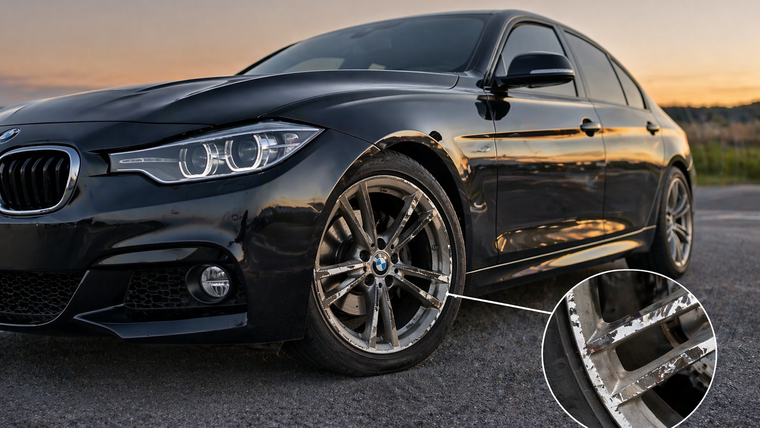
Faster corrosion. Standard wheel finishes aren't always tested against extended salt exposure. Once a chip in the clear coat lets salt reach bare aluminum, corrosion spreads under the finish, showing up as bubbling paint or pitted metal. Left long enough, this can compromise the bead seal where the tire meets the wheel, leading to a slow air leak that's genuinely hard to diagnose.
Pressure and seal issues. Alloy contracts more than steel in the cold. On a wheel not engineered with winter tolerances in mind, that extra contraction can loosen the seal between the tire bead and the rim edge just enough to cause a slow leak — the kind that shows up as a low-pressure warning every few weeks rather than a dramatic flat.
None of this means a standard factory wheel is unsafe for winter — most drivers use theirs every year without issue. It means the margin for error is smaller: less impact resistance, more corrosion risk, and a higher chance of ending the season with a cracked or slowly leaking wheel. That's the real argument for either buying wheels built for the conditions, or at minimum knowing your factory wheels' limits before you hit that first hidden pothole.
Getting the Size Right: Match, or Minus Size
Your winter wheels don't have to be the exact diameter as your summer set, and in a lot of cases they shouldn't be.
Matching your factory size is the simplest route. You order winter tires in your original tire size, mount them on wheels of the same diameter, and everything — TPMS calibration, speedometer accuracy, ground clearance — stays exactly as the manufacturer intended.
Minus sizing means dropping to a smaller wheel diameter — commonly one inch smaller — paired with a taller, narrower winter tire that keeps the overall tire diameter close to stock. This has real advantages in Canadian winters: a narrower tire cuts through snow more effectively by concentrating weight over a smaller contact patch, the taller sidewall adds a cushion against pothole damage, and smaller wheels are almost always cheaper to buy. If your vehicle came with 19-, 20-, or 22-inch factory wheels, minus sizing is worth serious consideration — both for the tire performance and for what you'll save on the wheels themselves.
The one rule that doesn't bend: always test-fit before committing to a full set. Brake caliper clearance and fender clearance vary by trim level even within the same model year.
What a Second Wheel Set Saves You
A dedicated winter wheel set represents a real upfront cost, and that's usually what stops people from buying one.
But run the math over a few seasons. Mount-and-balance service without a dedicated wheel set costs more per visit — you're paying to break down and remount every tire, twice a year, every year. With your own wheel set, that cost drops significantly and the job takes less shop time. Add in reduced rim damage, no risk of bead leaks from repeated mounting, and the resale value some dedicated wheel-and-tire packages hold, and the wheel set frequently pays for itself within three to five winters — sometimes faster if you were previously paying for full mount-and-balance twice a year at a dealership.
There's also a convenience value that doesn't show up on a receipt: with your own wheels, many drivers do the seasonal swap themselves or book a much shorter, cheaper appointment, instead of losing a morning at the shop during the busiest weeks of the tire-change season.
Keeping Winter Wheels in Good Shape Between Seasons
Whatever you buy, how you store and maintain your winter wheels determines how long they last.
During the season, rinse road salt and grime off your wheels regularly — every couple of weeks is a reasonable habit, and after any major salt application on the roads. Salt is corrosive on both steel and alloy, and it works fastest in the wheel wells where it accumulates and stays wet longest.
For storage, keep off-season wheels in a dry, temperature-stable space, away from direct sunlight and humidity swings. Stack tire-and-wheel assemblies lying flat rather than standing upright — standing them for months can create flat spots and uneven wear on the tire. A basement, garage, or storage unit works; avoid anywhere prone to dampness.
For inspection, check for cracks, bends, or curb damage before every mounting season, especially on alloy wheels. A cracked wheel is a safety issue, not a cosmetic one — it can fail under load, and it's not something to drive on and hope for the best.
Winter Tire Rules and What They Mean for Your Wheel Choice
Quebec requires winter tires bearing the official mountain-snowflake symbol on all passenger vehicles registered in the province, from December 1 to March 15, with fines for non-compliance. Other provinces, including British Columbia on designated highways, have their own seasonal requirements, and several — like Manitoba — offer low-interest financing programs that can be used toward winter tires, mounting, balancing, and wheels.
None of these rules mandate a separate wheel set — you're free to swap tires on and off your existing wheels every year. But the regulatory reality of mandatory seasonal changeovers is exactly why a dedicated set makes sense for so many Canadian drivers: if you're required to do this swap every single year regardless, minimizing the cost and hassle of that swap pays off every season you own the vehicle.
Making the Call
There's no universal right answer here — the best winter wheel setup depends on your vehicle, your budget, and how many winters you plan to keep the car. But the framework is simple: steel wheels for the best value and durability, alloy for weight savings and looks if you're willing to maintain them, minus sizing if your factory wheels are large and expensive to replace, and TPMS sensors if you don't want a warning light staring at you from December to March.
Whatever you land on, get the fitment right — bolt pattern, offset, and TPMS compatibility — before you buy, and take care of what you've got. A properly chosen and maintained winter wheel set will outlast several sets of tires and pay you back every single season.