
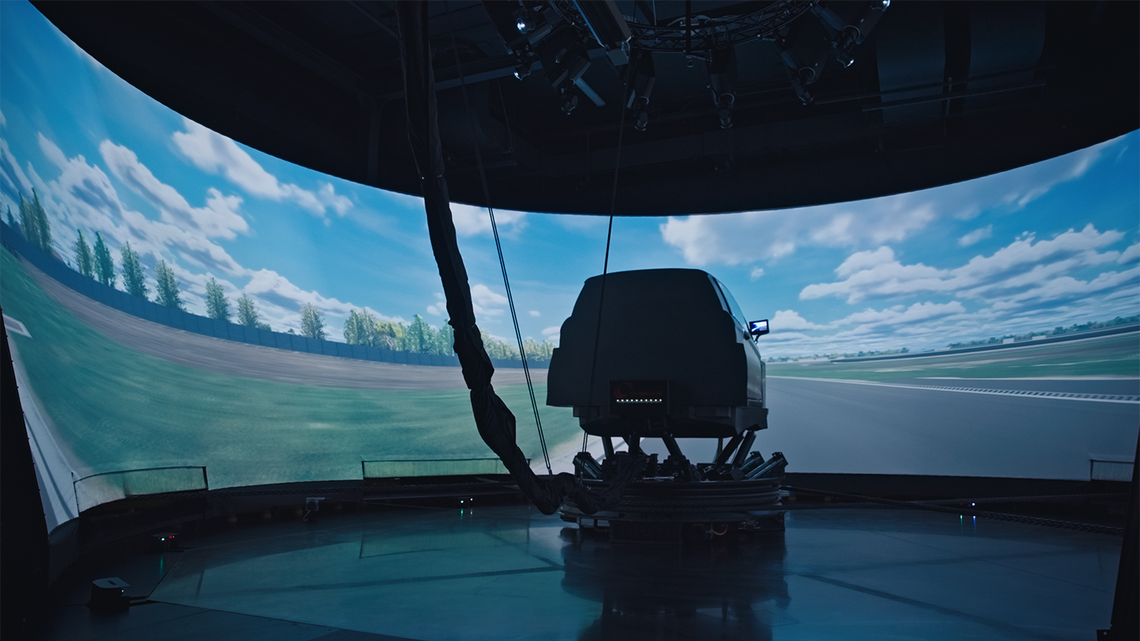
As cars become ever more connected, the development of their components is moving in the same direction. Bridgestone is taking a significant step in its transformation with a new Driver-in-the-Loop driving simulator that is now fully operational. Installed at Bridgestone’s research and development centre near Rome, the VI-grade DiM500 makes it possible to evaluate tire performance in a fully virtual environment. The company has been using what it calls Virtual Tyre Development for more than a decade. With this simulator, Bridgestone’s engineers are pointing to a new phase in which high‑fidelity simulations can be paired with real driving impressions... without ever leaving the lab!
An immersive tool for realistic testing
The DiM500 isn’t a basic simulator with a simple screen and a steering wheel. The system is built around a large motion platform offering five metres of travel, combined with a carbon‑fibre cockpit designed to immerse the driver in a hyper‑realistic environment. That motion capability helps recreate forces comparable to physical tests, which improves the precision of the analysis, especially for vehicle dynamics and driving feel.
For Bridgestone, the point is to combine multiple sources of insight: high‑fidelity simulations, the driver’s subjective feedback, historical data, and artificial intelligence tools. Together, these inputs are meant to support design decisions earlier and with greater accuracy, while allowing the team to explore a much larger set of options than a purely physical test program would typically allow.
Faster development, fewer prototypes
One of the most tangible benefits is a reduced need for prototypes during the development cycle. Bridgestone estimates this new capability could save up to 12,000 experimental tires per year, by reserving physical testing mainly for the final stages of validation. Track testing remains essential, but it could shift toward being a final confirmation rather than a repeated step at every iteration.
This approach also aligns with the company’s sustainability strategy. Bridgestone says its virtual development technology can already reduce raw‑material consumption and CO₂ emissions during the development phase of original equipment tires by up to 60%. By enabling tires and vehicles to be developed in parallel, the simulator is also intended to shorten time to market and strengthen collaboration with automakers.
For now, the simulator is primarily used for dry‑handling evaluations, but it’s reasonable to expect it will be adapted to c over more performance conditions. Only time will tell what kinds of products the Japanese manufacturer will build with this cutting‑edge technology.