
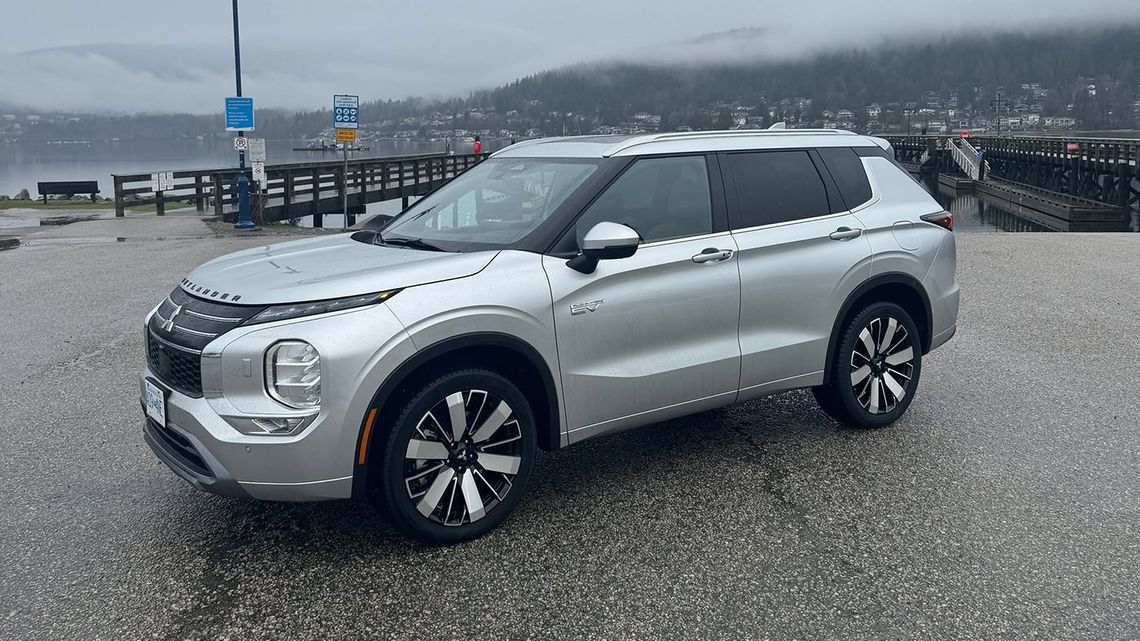
Around Vancouver, between Port Moody and the winding roads of Belcarra, Mitsubishi invited us to take the wheel of the new 2026 Outlander PHEV, a model that does not attempt to reinvent an already well‑established formula. In this damp, forested setting, one impression quickly stands out: silence. Cabin insulation has been improved and, in electric mode, the vehicle moves almost without noise, immediately reinforcing its sense of refinement.
This more polished finish arrives at a strategic moment, as the Outlander PHEV has dominated plug‑in hybrid vehicle sales in Canada for three consecutive years. Introduced in 2018, it gradually gained ground as consumers became more familiar with plug‑in hybrid technology. For 2026, Mitsubishi therefore focuses less on surprise and more on targeted improvements intended to make its SUV more comfortable, more mature, and more efficient in everyday use.
Battery, tires and road behaviour
The main evolution lies under the bodywork. The battery has been revised to increase both power and efficiency. According to Mitsubishi, its output has increased by roughly 60 percent, allowing for smoother acceleration. Electric range now reaches about 72 kilometres, an increase of just under 20 percent.
Mitsubishi also highlighted the Yokohama BluEarth Winter V906 tires fitted on the test vehicles. These winter tires use an advanced polymer compound designed to improve performance on snow while maintaining good grip on dry pavement. Their tread pattern also features adaptive 3D sipes intended to multiply contact edges on snow and ice.
On the roads of British Columbia, the vehicle proved reassuring and easy to drive, particularly thanks to the S‑AWC system, which adjusts torque distribution between the wheels to optimize stability on wet pavement. By the end of the drive, we recorded an average consumption of about 4 L/100 km, a relatively low figure for this category.
A modernized cabin
From the outside, changes remain subtle. The silhouette stays essentially the same, despite new wheel designs and a few aerodynamic tweaks. Most updates are found inside the vehicle. The cabin retains the "horizontal axis" design philosophy, with a wide dashboard that enhances the sense of space. Materials have been slightly improved, including suede‑like surfaces on certain trims.
All versions now receive a 12.3‑inch infotainment screen along with a digital instrument cluster of the same size. Mitsubishi also adds an exclusive Yamaha audio system available starting from the base trims.
The 2026 Outlander PHEV does not try to reinvent the formula. Instead, Mitsubishi continues refining an already well‑established product capable of driving much of the time in electric mode while retaining the flexibility of a gasoline engine for longer trips. Could that be why the model remains so popular in Canada? We will have to keep an eye on the sales numbers.