
In the first part of my story, I left off at Lake Towada after an already eventful morning in my Toyota Yaris featuring a giant Buddha, Oirase Gorge, narrow roads and a few accidental uses of the windshield wipers while trying to signal. The Yaris was not done yet, however. The strangest part of my road trip in Japan was still ahead of me: crossing the mountains to the tiny village of Shingo to visit what the region presents, with complete seriousness, as the Tomb of Jesus.
Into the Deep Countryside
After leaving Lake Towada, traffic thinned out, houses became increasingly scarce and the roads quickly turned much more rural. I was entering what the Japanese call the inaka, or deep countryside. After several hours behind the wheel, driving on the left was finally beginning to feel natural. I could even use the turn signal with an almost respectable success rate.
This was where I truly came to appreciate the Yaris. Its compact size was exactly what I needed on these winding roads. It was easy to drive and remained predictable through the corners. In Japan, where an open ditch often replaces the shoulder, those are qualities you quickly learn to value.
Jesus Apparently Died in Shingo
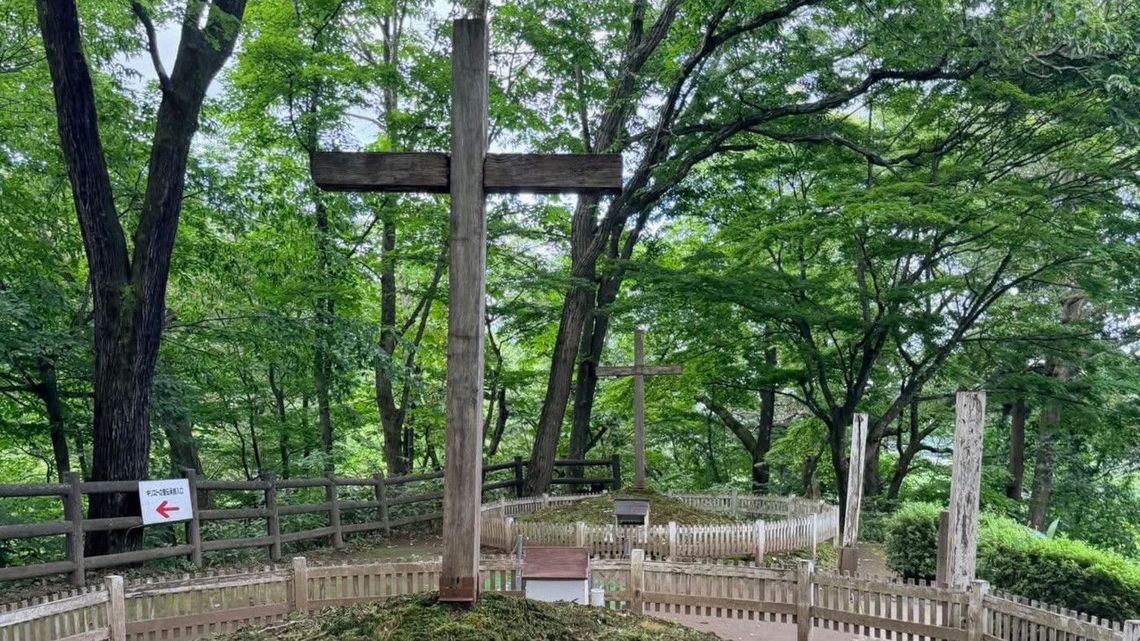
Finally, I reached the part of the trip I had really been looking forward to telling you about. According to local legend, Jesus did not die on the cross. His brother Isukiri took his place while Jesus travelled across Siberia and eventually settled in Japan.
Two burial mounds stand at the top of a small hill. One supposedly contains the remains of Jesus, while the other belongs to his brother. A festival is held there every year, featuring the Nanyadoyara, a traditional song with mysterious lyrics that some people have compared to Hebrew.
My plan was to follow the visit with a bowl of “Jesus ramen” at a nearby restaurant. Unfortunately, it was closed. Perhaps Christ had already given enough for one day. We continued toward Gonohe instead, where I ate basashi: raw horse meat served in thin slices. After dinner, all that remained was to drive to Hachinohe, fill up the tank and return the Yaris. I arrived at around 6:45 p.m., tired but incident-free and with an almost complete mastery of the Japanese turn signal.
The Yaris was neither powerful nor luxurious. It was, however, perfect for this journey: compact, predictable and discreet enough never to make things more complicated. In a single day, it had taken me from a giant Buddha to the Japanese Tomb of Jesus, with a gorge, a volcanic lake and a plate of raw horse meat in between. It would have been difficult to ask for more