
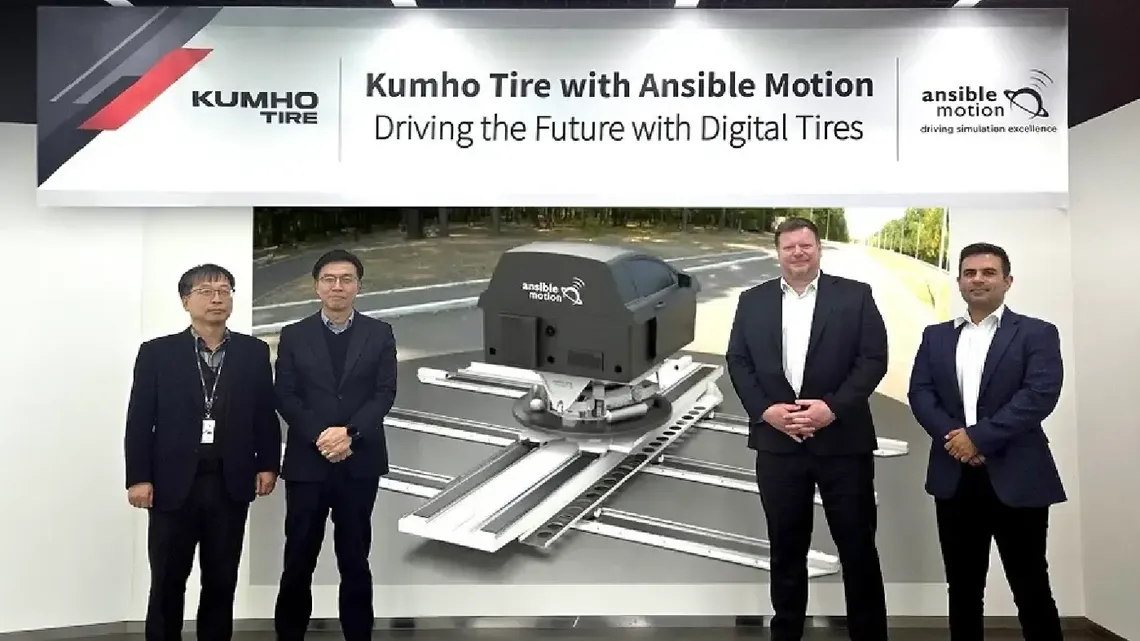
For as long as anyone can remember, developing a new tire has meant a mix of road testing, prototypes, and endless rounds of tweaking. Effective, sure… but also slow and expensive. Today, with electric vehicles and high-performance models becoming the norm, innovation is moving faster than the market can comfortably keep up. That’s the backdrop for Kumho’s partnership with Ansible Motion, a company specialized in advanced simulation, to push its R&D into a new era: digital tires and virtual testing.
Innovation, faster
Modern tires have to meet a growing list of demands. EVs, for example, tend to be heavier, deliver instant torque, and require careful control of comfort and noise. And then there’s range anxiety: even a small improvement in rolling resistance can translate into meaningful extra kilometres. Add regenerative braking, which changes how the tire behaves during deceleration, and it’s clear engineers can’t just “do what they’ve always done.”
The result is that even a small change in rubber compound or tread pattern can trigger multiple prototype runs and long road-test cycles (often dependent on weather, available surfaces, test drivers, and a dozen other variables). Kumho wants to bring more of that evaluation earlier into the process, using digital tools to compare scenarios quickly and reduce the number of expensive back-and-forth iterations before a physical tire is even built. That’s where Ansible Motion comes in.
The Delta S3 Spin DIL simulator
At the center of the partnership is Ansible Motion’s Delta S3 Spin DIL. In plain terms, it’s a driving simulator designed to replicate real-world road conditions with impressive realism, allowing engineers to evaluate vehicle dynamics, safety, and ride comfort without leaving the lab. It uses a six-degrees-of-freedom motion system with infinite yaw, paired with a 360-degree projection setup that creates a truly immersive environment. Different vehicle cabins can be swapped in depending on the test, and the open software architecture makes it easier to update the system and integrate it with other testing setups.
Of course, the goal isn’t to replace road testing entirely, but rather to complement it in a smarter way. DIL simulators enable detailed digital analysis of tread design, casing construction, and rubber compounds, while also capturing real-time feedback from human drivers. By linking virtual and physical testing, Kumho aims to refine its predictive models and tighten the correlation between simulation results and what actually happens on the road.
In the end, the idea is pretty simple: develop faster, test earlier, and build tires that are better suited to the mobility of tomorrow. For Kumho, it’s also a clear way to strengthen competitiveness in a market where innovation never really slows down.