
Two pickups can sit side by side in a parking lot on tires that look almost the same, yet behave completely differently on a wet highway in November or a rutted logging road in April. The difference usually comes down to three letters: AT, RT or MT.
Choosing between AT vs RT vs MT tires isn't about finding the "best" one. It's about matching the tire to how you actually drive, where you live and what your winter looks like. This guide explains how each type is built, how it performs on pavement, off-road and in snow, what it really costs over its life, and which provincial winter rules apply to it.
AT, RT and MT: What the Letters Actually Mean
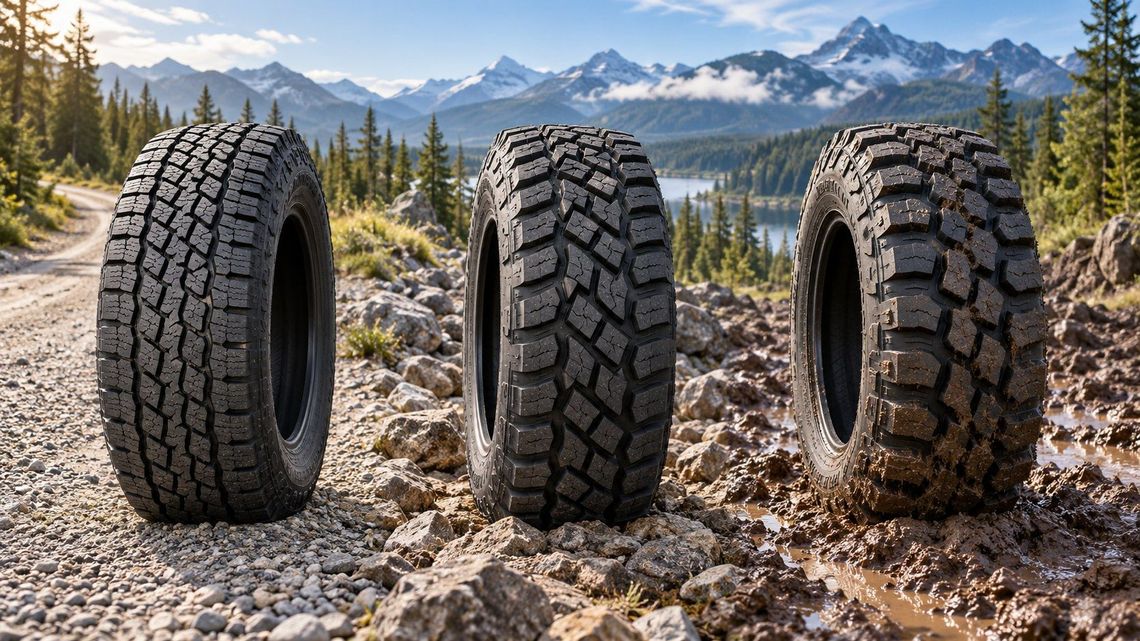
All three are light truck and SUV tires designed to leave the pavement. What separates them is the balance between road manners and off-road grip.
All-Terrain (AT)
The all-terrain tire is the generalist. Its tread blocks are tightly spaced and cut with plenty of sipes, the thin slits that add biting edges. That design keeps the tire quiet and stable on the highway while giving enough grip for gravel, dirt roads, light mud and snow. Most AT tires use a firmer rubber compound, which helps them last longer.
Mud-Terrain (MT)
The mud-terrain tire is the specialist. It uses large lugs separated by wide, deep voids (the open channels between the blocks). Those voids let mud, stones and loose soil fly out as the tire turns, so the lugs keep finding fresh grip. Sidewalls are thick and the tread pattern often wraps down the side for traction at low pressure. The trade-off: fewer sipes and less rubber touching the road.
Rugged-Terrain (RT)
The rugged-terrain tire is the newest of the three and sits squarely between them. Most RT designs pair an AT-style centre tread, for steadier road manners, with aggressive MT-style shoulder blocks and reinforced sidewalls. You get more bite in mud and rock than an AT, with less noise and faster wear than a full mud tire.
| Criteria | ATAll-Terrain | RTRugged-Terrain (hybrid) | MTMud-Terrain |
|---|---|---|---|
| Best use | Mostly pavement, with gravel and dirt road trips (roughly 70 to 90% on-road) | Mixed road and trail use, roughly half and half | Mostly off-road: deep mud, rock, demanding trails |
| Tread design | Tight tread blocks and plenty of sipes | AT-like centre, aggressive MT-style shoulders | Large lugs, very wide voids, few sipes |
| On-road comfort and quiet | 4/5Smooth ride, moderate noise | 3/5Louder than an AT, much quieter than an MT | 1/5Noticeable hum at highway speeds |
| Wet pavement grip | 4/5Sipes clear water effectively | 3/5Decent, with fewer sipes than an AT | 2/5Smaller contact patch, longer stopping distances |
| Mud and loose ground | 2/5Fine in light mud over a firm base | 4/5Strong traction in moderate mud and ruts | 5/5Excellent: wide voids clean themselves out |
| Rock and sidewall toughness | 3/5Moderately reinforced sidewalls | 4/5Reinforced sidewalls with side biters | 5/5Very tough sidewalls built for rock |
| Snow and ice | 4/5Good in snow, many models carry the 3PMSF symbol | 3/5Varies by model, some are 3PMSF | 2/5Good in deep, soft snow, weak on ice |
| Fuel economy | 4/5Lowest rolling resistance of the three | 3/5Middle of the pack | 2/5Heavy tire, higher fuel use |
| Tread life | 4/5Firmer compound, mileage warranty common | 3/5Mileage warranty on some models | 2/5Wears fast on pavement, mileage warranty rare |
| Price | Most affordable in the same size | Mid-range | Usually the most expensive |
| Winter rules | 3PMSF models count as winter tires in Quebec (Dec. 1 to Mar. 15) and BC | Quebec-compliant only if the sidewall shows the 3PMSF symbol | Often M+S only: accepted on designated BC routes (3.5 mm min.), not compliant in Quebec |
| Who it's for | Commuters, families, towing, cottage trips | Hunting, fishing, job sites, logging roads | Trail enthusiasts, dedicated off-road rigs |
How to read the scores: 1 to 5 scale, a higher score means better performance for that criterion. These are general category trends: results vary from one model to another. Before winter, always check the sidewall markings and your province's rules.
On the Road: Noise, Comfort, Wet Grip and Fuel
Most trucks spend the bulk of their kilometres on pavement, even the ones that see real trails. That's where the differences show up in your wallet and your patience.
Noise is the first thing drivers notice. Big lugs with big gaps slap the pavement and create a hum that climbs with speed. An MT is loud on the highway. An AT sounds close to a regular light truck tire. An RT lands in between.
Wet grip matters more than most buyers expect. Sipes and grooves pump water out from under the tire. Because MT tires have fewer sipes and a smaller contact patch, they need more distance to stop on wet pavement and give less warning before they slide. On rainy coastal BC highways or slushy Ontario commutes, that's a safety issue, not a comfort one.
Fuel economy follows weight and rolling resistance. MT tires are heavier and flex more as they roll, so they burn more fuel. An RT costs less at the pump than an MT, and an AT is the most efficient of the three. Going up in tire size makes each of these effects stronger.
Off-Road: Gravel, Mud, Rock and Snowpack
Off the pavement, the ranking flips.
On gravel and hard-packed dirt, a good AT does the job well. Its tighter blocks resist stone drilling (small rocks wedging into the grooves) and it stays predictable on rural roads at speed.
In mud, void space wins. Once an AT's narrow grooves pack with clay, the tread behaves almost like a slick. An RT clears moderate mud and ruts far better, and an MT is built for the deep, sticky conditions you find on farm fields, spring logging roads and hunting trails.
On rock, sidewall strength matters as much as tread. The reinforced sidewalls and side lugs on RT and MT tires resist cuts and add grip when you air down. Lower pressure off-road does improve traction, but always reinflate to the recommended pressure before getting back on pavement. An under-inflated tire overheats at highway speed.
Winter in Canada: M+S, 3PMSF and Provincial Rules
This is where truck owners most often get caught off guard.
M+S is not the same as 3PMSF
M+S (mud and snow) is a marking based on tread geometry. A manufacturer can apply it without ever testing the tire on snow. The Three-Peak Mountain Snowflake (3PMSF) symbol is different: the tire must pass a standardized traction test on medium-packed snow and outperform a reference tire. Many AT tires now carry the 3PMSF symbol. Some RT tires do. Most MT tires carry M+S only.
What the provinces require
Winter tire rules vary across Canada, so check yours before the season starts. Two examples show how different they can be:
Quebec: from December 1 to March 15, every passenger vehicle registered in Quebec must run tires bearing the 3PMSF pictogram, or studded tires. An M+S-only mud tire does not qualify.
British Columbia: on most designated highways from October 1 to April 30 (some routes end March 31), tires must show M+S or 3PMSF and have at least 3.5 mm of tread. An M+S mud tire is legal there. Legal, however, doesn't mean ideal.
Most other provinces have no general winter tire mandate, but that doesn't mean winter tires don't matter. In Ontario, for example, insurers must offer a discount to drivers who install winter tires, so it's worth asking yours what qualifies.
How they really perform in snow and ice
Even a 3PMSF all-terrain is a compromise. It has passed a snow test, but its compound doesn't stay as soft in deep cold as a dedicated winter tire, and it doesn't grip ice the same way.
Mud tires do surprisingly well in deep, loose snow because their lugs paddle through it. On packed snow and ice, though, few sipes and hard lugs mean long stopping distances. Some AT and MT models are studdable, which helps on ice where studs are allowed. Stud rules also vary: Quebec, for instance, allows them from October 15 to May 1.
If you live in a snowbelt, on the Prairies, in northern Ontario or anywhere with icy roads for months, a dedicated winter set remains the safest choice, whatever you run in summer.
Tread Life, Warranties and the Real Cost per Kilometre
Sticker price only tells part of the story. At the same size, MT tires usually cost the most, wear the fastest on pavement and rarely come with a mileage warranty. AT tires often do. RT tires vary by model.
A simple way to compare: divide the price of the set by the kilometres you expect to get, then factor in fuel. A cheaper tire that wears out twice as fast isn't cheaper.
A few points protect your investment:
Rotate regularly. Aggressive tread wears unevenly when it isn't rotated. Every 8,000 to 10,000 km is a common interval, but follow the tire maker's schedule.
Keep your records. Treadwear warranties typically require proof of rotation and correct inflation.
Read the exclusions. Damage from off-road use is often excluded from manufacturer warranties. A road hazard protection plan can cover punctures and impact damage on the road. (Internal link: Road Hazard Protection page)
Load Range, Towing and Sizing
Many AT, RT and MT tires come in LT (light truck) sizes with load ranges such as C, D or E, where E corresponds to a 10-ply rating. A higher load range handles heavy payloads and trailers better, but rides firmer and needs higher inflation pressure. Always meet or exceed the load index your vehicle requires. (Internal links: LT vs passenger tires guide, load range guide)
Planning to go bigger? A larger tire changes your speedometer and odometer readings, can affect stability and ABS systems, and may rub on suspension or fender liners. Check clearance first and have the speedometer recalibrated afterward.
Which Tire Type Should You Choose?
Choose an AT tire if most of your driving is on pavement, you take gravel roads to the cottage or the campsite, you tow occasionally and you want one quiet, long-lasting tire, ideally with the 3PMSF symbol for year-round use where the law allows it.
Choose an RT tire if your truck splits its time between road and trail: hunting and fishing access roads, job sites, forestry roads or rural properties where mud and rock are common. You accept a bit more noise in exchange for tougher sidewalls and more grip.
Choose an MT tire if your vehicle is built for off-road use first, you regularly face deep mud or rock, and you're ready to trade comfort, fuel and tread life for maximum traction. Plan a separate winter set for icy roads.
Whatever you pick, run the same tire on all four corners. Mixing types, especially on 4x4 and AWD vehicles, upsets handling and can strain the drivetrain.
Frequently Asked Questions
Are RT tires good year-round? They can be in mild regions, and some RT models carry the 3PMSF symbol. Where winters are icy, or where the law requires 3PMSF, check the sidewall before counting on them in winter.
Can I use mud tires in winter? They handle deep snow reasonably well but struggle on ice and packed snow. Most MT tires carry only M+S, which isn't accepted as a winter tire in Quebec.
Are AT tires noisier than regular tires? Slightly, yes. Modern AT tires are much quieter than they used to be, and the gap with a highway tire is small compared to an MT.
Do I need a 4x4 to run MT tires? No, but their strengths mostly show up off-road, where a 4x4 makes the most of them. On a two-wheel-drive truck used mainly on pavement, an AT is the better fit.
Conclusion
The AT vs RT vs MT tires decision comes down to three questions: where you spend most of your kilometres, how rough your off-road use really is, and what winter looks like in your province. For most truck and SUV owners, an all-terrain tire is the right balance. An RT makes sense when trails and job sites are a regular part of your week, and an MT is worth its trade-offs only when off-road performance comes first.
Browse all-terrain, rugged-terrain and mud-terrain tires on Blackcircles.ca, filter by your truck's size, and check the sidewall markings before winter.