
Two heavyweights of the Canadian winter go head to head. Here's how they actually compare on ice, in snow, and over the long haul.
Choosing a winter tire rarely comes down to comparing specs on paper. It comes down to how your vehicle will react the first time you have to brake hard on a patch of ice hidden under an inch of fresh snow, somewhere between Kingston and Sudbury. Two models keep coming up in conversation this season: the brand-new Bridgestone Blizzak IcePeak, positioned as the brand's new flagship, and the Michelin X-Ice Snow+, the upgraded version of a tire already known for being dependable.
Both target the same segment: a versatile, studless winter tire built for cars, crossovers, and family SUVs. But they get there through different technical approaches, which translates into distinct strengths depending on your driving conditions.
Quick Introduction to Both Contenders
The Blizzak IcePeak isn't a simple refresh. It single-handedly replaces two full Bridgestone lineups, the WS90 and the DM-V2, with the goal of simplifying the choice for drivers while covering a very wide size range, from 14 to 22 inches. It's a tire designed from the ground up for gas, hybrid, and electric vehicles, an increasingly relevant consideration as Canada's vehicle fleet electrifies.
The X-Ice Snow+ follows a different logic. Rather than starting from scratch, Michelin kept the same tread pattern as the original X-Ice Snow, a tire already well rated after several years on the market, and focused its efforts on the rubber compound. The idea: keep what already worked and push performance further without sacrificing the durability the lineup is known for.
Key takeaway: the Blizzak IcePeak is a full redesign (tread, compound, technology), while the X-Ice Snow+ refines an already proven base by touching only the rubber formulation. Both manufacturers, however, target the same priorities: ice braking, snow traction, longevity, and fuel efficiency. Few independent tests have compared the two models head to head so far, so most of the performance claims below come from each manufacturer's own internal testing.
The Technology Beneath the Tread
Bridgestone: The MultiCell Compound and ENLITEN Technology
The Blizzak IcePeak relies on Bridgestone's patented MultiCell compound, designed specifically to clear the thin film of water that forms on the surface of ice as a tire rolls over it. That invisible film is what makes ice so treacherous; without it, friction would be far better. Bridgestone also built in its ENLITEN technology, aimed at balancing winter performance, durability, and rolling resistance, a factor that directly affects fuel consumption.
Full-depth 3D sipes keep their effectiveness as the tire wears, unlike shallower sipes that lose their bite after a couple of seasons.
Michelin: Flex-Ice 3.0 and EverGrip Technology
The X-Ice Snow+ introduces the Flex-Ice 3.0 compound, an evolution of the Flex-Ice 2.0 found on the previous model. This silica-based compound is formulated to stay flexible even in extreme cold, which matters: rubber that stiffens below freezing loses a lot of its grip, no matter how good the tread design is. Michelin's EverGrip technology adds a rigid polymer to the mix, aimed at maintaining grip on snow and ice even as the tire approaches the end of its useful life.
Maxtouch technology, meanwhile, maximizes the contact patch with the road, distributing forces more evenly during braking, acceleration, and cornering.
Ice Performance
Both tires now carry the same double sidewall marking: the 3PMSF certification (the mountain-snowflake symbol, confirming adequate performance in severe snow) and the Ice Grip certification, a newer standard specifically focused on braking on icy pavement. Bridgestone points out that the Blizzak IcePeak is the first tire in its own lineup to earn both, a milestone for the brand rather than an advantage unique to the market. Michelin has reached the same milestone with the X-Ice Snow+, which also earns the Ice Grip symbol in addition to the 3PMSF already present on the X-Ice Snow.
The X-Ice Snow+ claims roughly a 4% improvement in ice braking over the X-Ice Snow, a lineup already known for predictable, progressive behaviour on this surface. Bridgestone, for its part, leans heavily on its MultiCell compound and this dual certification as the central marketing argument for the IcePeak's launch.
Bottom line: both manufacturers treat ice as a top priority, and both now hold the same two certifications. The distinction says more about each brand's own product evolution than about a genuinely unique capability on either tire. No large-scale independent testing currently confirms that one model brakes shorter than the other on ice; the figures circulating come from each manufacturer's internal testing.
Snow Performance
On fresh, compact snow, both models use full-depth 3D sipes, an approach shared by most premium winter tires today. The Blizzak IcePeak relies on optimized tread blocks aimed at maximizing traction, including in extreme winter conditions.
The X-Ice Snow+ keeps the X-Ice Snow's V-shaped tread pattern, known for clearing packed snow from between the blocks effectively, a factor that matters just as much as raw traction: a tire that clogs quickly with packed snow loses effectiveness no matter how good its sipes are. Michelin still claims about a 1% gain in snow performance over its predecessor, a modest number that suggests most of the engineering effort went into ice and wet-road performance rather than snow, already a strong point for the lineup.
Comfort, Noise, and Durability
The X-Ice Snow+ benefits from Michelin's Piano Acoustic Tuning technique, which varies the spacing and width of tread blocks to break up repetitive sound frequencies, one of the main sources of road noise. That's a real advantage for anyone putting in a lot of highway kilometres over the winter. The X-Ice lineup is also historically known for its longevity, with many owners reporting solid performance across multiple full seasons.
The Blizzak IcePeak, for its part, relies on ENLITEN to optimize durability and fuel efficiency. It's still a new tire in the North American market, so long-term wear data remains to be confirmed over the coming seasons, unlike the X-Ice Snow+, which inherits the reliability track record of its predecessor.
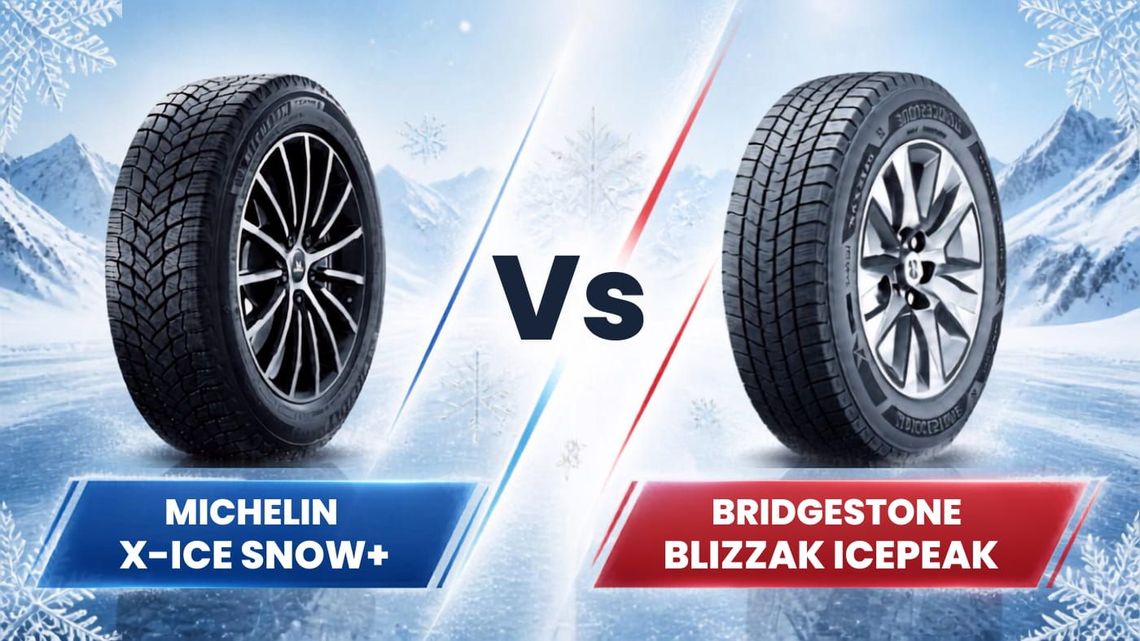
Bridgestone Blizzak IcePeak vs Michelin X-Ice Snow+
Which Tire Fits Your Driving Profile
If your daily routes cross areas where icy patches are common, poorly cleared outdoor parking, a hill that doesn't get plowed well, a rural road low on the snow-removal priority list, the Blizzak IcePeak offers an interesting consideration: Bridgestone builds its launch messaging around ice braking, backed by its dual 3PMSF and Ice Grip certification. Keep in mind, though, that the X-Ice Snow+ carries the same two certifications.
If you drive mostly on the highway, where comfort and noise levels matter just as much as raw safety margins, and you're looking for a tire with a durability reputation that's already well documented across several seasons, the X-Ice Snow+ remains a solid, reassuring choice, benefiting from the real-world experience built up over the previous generation, a track record the brand-new IcePeak hasn't had the chance to build yet.
Either way, the exact size, load index, and speed rating compatible with your vehicle remain the mandatory starting point before choosing between the two brands. And since independent testing directly comparing the two models is still scarce, much of the decision still comes down to your driving priorities rather than independently verified numbers.