
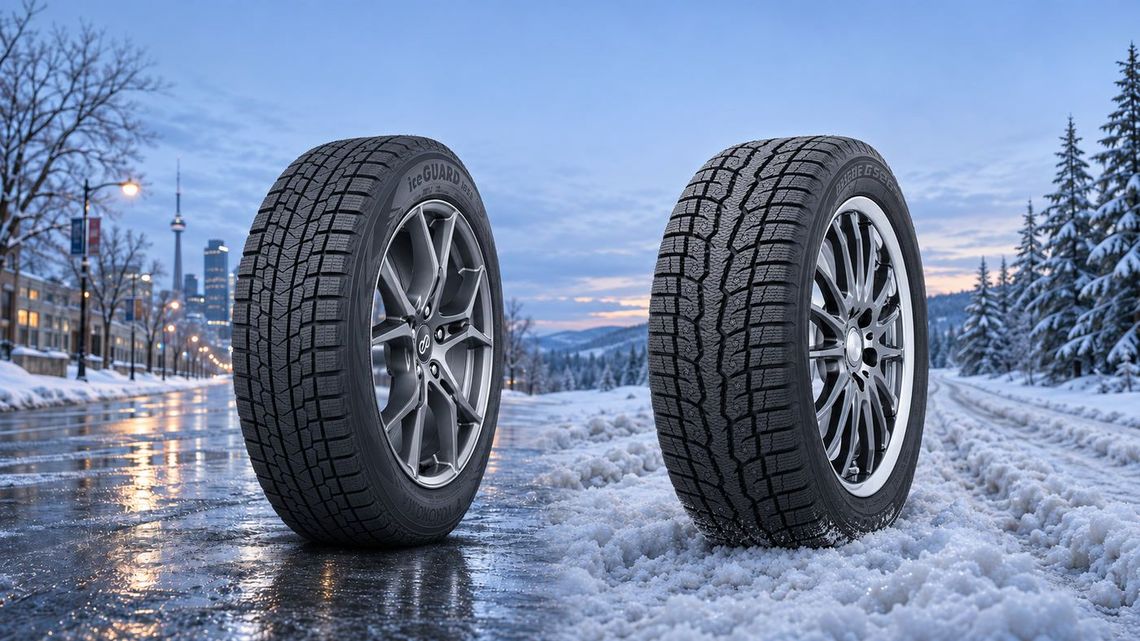
On paper, the Yokohama iceGUARD iG53 and the Toyo Observe GSi-6 look like twins. Both are studless winter tires from Japanese manufacturers, both carry the Three-Peak Mountain Snowflake (3PMSF) symbol, and both are built for the kind of winter that Canadian drivers know too well: black ice at intersections, slush on the highway and packed snow on side streets.
The differences show up when you look closer. These two tires attack ice in completely different ways, they cover different vehicles, and they don't offer the same speed ratings. This comparison walks through the technology, the sizes, the certifications, the warranties and the real-world scenarios where one makes more sense than the other.
iG53 vs GSi-6 at a Glance
| Yokohama iceGUARD iG53 | Toyo Observe GSi-6 | |
|---|---|---|
| Type | Studless winter | Studless winter |
| Severe snow symbol (3PMSF) | Yes | Yes |
| Ice Grip certification | Not announced by Yokohama | Shown by Toyo, but not on every size |
| Key ice technology | Absorptive tread compound | Microbit compound (crushed walnut shells) |
| Main vehicles | Cars, minivans, compact crossovers | Cars, crossovers, SUVs, light trucks |
| Size range in Canada | Mostly 14 to 18 inches | 135 sizes, 14 to 22 inches |
| Typical speed ratings | T or H | H or V |
| New tread depth | 11/32" to 12/32" (8.7 to 9.5 mm) | Mostly 11/32" to 13/32" (8.7 to 10.3 mm) |
| Mileage warranty | None | None |
Sources: Yokohama, Toyo Tires Canada, Tyre Reviews. Always confirm the specs of your exact size before buying.
Two Different Ways to Grip Ice
Ice isn't slippery because it's hard. It's slippery because a thin film of water forms on its surface, especially when the temperature hovers near freezing or when tires press and rub against it. That film acts like a lubricant. Every studless winter tire is, at its core, an answer to one question: how do you get the rubber through that water and onto the ice itself?
iceGUARD iG53: Absorbing the Water Film
Yokohama's answer is chemistry. The iG53 uses an absorptive tread compound designed to reduce micro-hydroplaning on icy surfaces. The idea is to draw the water film away so the rubber touches the ice rather than the water sitting on it.
Yokohama adds micro diagonal grooves to the tread surface. They create extra biting edges from the very first kilometre, so the tire grips on ice without a long break-in period. Under the tread, a low-heat-generating compound adds stiffness and lowers rolling resistance, which helps fuel economy.
Observe GSi-6: Biting Into the Ice
Toyo's answer is mechanical. The GSi-6 uses Toyo's Microbit Technology, a compound with crushed walnut shells embedded in the tread. As the tire rolls, those hard particles dig into the ice surface, a bit like a microscopic version of studs, without the noise or the road damage.
Toyo also includes a shallow "first edge" sipe across the tread to help traction during the break-in period. So both manufacturers took the break-in problem seriously, just with different tools.
What this means for you: neither approach is "better" in every situation. Absorbing water is especially useful on wet ice near 0 °C, the condition you'll often find in coastal British Columbia, southern Ontario or the Maritimes. A mechanical bite is especially useful on hard, cold ice, the kind common in the Prairies and northern regions. Both tires are designed to handle both conditions, but their engineering priorities are different.
Tread Design: Snow, Slush and Wet Roads
Both tires use a directional tread pattern, and both rely heavily on 3D sipes. The way they organize the rest of the tread is where they differ.
The iG53 combines zigzag main and intermediate grooves, a wide centre rib and 3D triple sipes. The 3D sipes support each other, so the tread blocks don't fold under load. That keeps more rubber in contact with the road when braking or turning on ice and snow.
The GSi-6 has a more aggressive design for deep snow and slush:
- A serrated centre stability rib for highway stability and extra bite in deep snow
- Large inner blocks with saw-toothed edges
- Split offset shoulder blocks for lateral grip in corners
- "Snow claws" inside the grooves for traction in deep snow
- Four circumferential grooves and tapered evacuation grooves to push water and slush out of the contact patch
- Multi-wave 3D sipes and a 360-degree spiral edge sipe
If your winters involve a lot of unplowed snow or deep slush ruts, the GSi-6's design is clearly built with that in mind. If you drive mostly on cleared roads with patches of ice, the iG53's emphasis on contact area and ice grip fits that use well.
Sizes and Speed Ratings: Which Vehicles Fit?
This is often the deciding factor, and it's where the two tires differ the most.
iceGUARD iG53: Built for Cars and Minivans
Yokohama designed the iG53 for passenger cars, minivans, coupes and compact crossovers. It launched in 32 sizes from 14 to 18 inches, and most sizes carry a T (190 km/h) or H (210 km/h) speed rating. A few larger sizes have been added since, but the iG53 remains a passenger car tire first.
Driving a mid-size or full-size SUV? Yokohama's dedicated option is the iceGUARD G075, developed for crossovers, SUVs and light trucks.
Observe GSi-6: One Name, Many Constructions
Toyo took a broader approach. The GSi-6 is offered in 135 sizes from 14 to 22 inches in Canada, covering compact cars all the way to half-ton pickups. Toyo adjusts the construction by segment: the HP version targets sport coupes and sedans, while the LS version targets SUVs and crossovers.
Nearly every size carries an H or V (240 km/h) speed rating. For drivers of performance sedans or premium crossovers that came from the factory with H or V rated tires, that's a real advantage.
Is a Lower Speed Rating a Problem in Winter?
Not usually. Installing winter tires with a lower speed rating than your original tires is common practice, and Toyo's own warranty excludes winter tires from its speed rating requirement. The rule is simple: never exceed the speed rating of your winter tires. Some drivers simply prefer to match their original rating, and in that case the GSi-6 gives you more options.
Ice Grip Certification: What It Changes
The 3PMSF symbol certifies traction in snow. It says nothing about ice. That's why the Ice Grip symbol was created: it certifies a tire's braking performance on ice.
Here's how the two tires compare:
- Toyo displays the Ice Grip certification for the Observe GSi-6, but it doesn't appear on every size. Check the sidewall or the product sheet of your specific size.
- Yokohama doesn't advertise an Ice Grip certification for the iG53.
Keep this in perspective. A tire without Ice Grip certification isn't necessarily bad on ice; it simply hasn't been certified to that standard. Still, if ice is your main concern and your size carries the symbol, it's an objective point in the GSi-6's favour.
What Independent Testing Says
Head-to-head testing between these two tires doesn't exist, so be wary of any article claiming one stops "X metres shorter" than the other.
What we do have: the iG53 was part of the Tyre Reviews 2022/23 studless winter tire test in size 205/55R16, where it finished 5th out of 7. Its ice braking was on par with premium rivals, and its rolling resistance was lower than the premium average. That's a solid result for ice and fuel economy, with weaker scores in other categories.
The GSi-6 hasn't appeared in major independent magazine tests. Its reputation rests mostly on Canadian owner feedback, which consistently highlights ice traction, deep snow performance and quiet ride.
Warranty and Long-Term Cost
Neither tire has a mileage warranty. That's normal for studless winter tires, since manufacturers prioritize grip over treadlife guarantees.
Both are covered against manufacturing defects (workmanship and materials) for the life of the usable tread, within a time limit set by each manufacturer. Toyo Canada's Millennium warranty, for example, covers defects for the original usable tread or 5 years from the date of manufacture, whichever comes first. Read the Canadian warranty booklet for each brand before buying, and keep your invoice.
A few points that apply to both:
- Road hazards (potholes, nails, curb impacts) aren't covered by manufacturer warranties. If you drive on rough roads, ask about road hazard protection when you buy.
- Rotate every 8,000 km or so. Toyo requires a documented rotation schedule to process certain claims, and regular rotation helps winter tires wear evenly.
- Watch the 50% mark. Toyo notes that winter traction drops considerably as tires approach 50% tread wear. A winter tire can be legal and still lose much of its grip in deep snow.
Winter Tire Rules Across Canada
Your choice also depends on where you drive. Winter tire rules vary by province:
- Quebec: winter tires are mandatory on passenger vehicles from December 1 to March 15 (SAAQ).
- British Columbia: winter tires (3PMSF or M+S) are required on many highways from October 1 to March 31, and until April 30 on some mountain routes.
- Ontario: winter tires aren't mandatory, but insurers must offer a discount to drivers who use them.
- Manitoba: Manitoba Public Insurance offers low-interest financing for winter tires through its Winter Tire Program.
Both the iG53 and the GSi-6 carry the 3PMSF symbol, so either one meets the requirements in Quebec and British Columbia.
Which One Should You Choose?
Choose the Yokohama iceGUARD iG53 if:
- You drive a compact car, a sedan or a minivan with T or H rated tires
- Most of your driving happens on cleared urban roads with patches of wet ice
- Fuel efficiency and a quiet ride matter to you
- Your size is available and the price works for your budget
Choose the Toyo Observe GSi-6 if:
- Your vehicle needs H or V rated tires, or a size above 18 inches
- You drive a crossover, an SUV or a light truck (look for the LS version)
- You regularly face deep snow, slush ruts or unplowed rural roads
- Ice Grip certification matters to you and your size carries it
Driving a larger SUV and prefer Yokohama? Look at the iceGUARD G075 instead of the iG53.
Frequently Asked Questions
Can I install studs in the iG53 or the GSi-6?
Both are designed as studless tires. Toyo sells a separate tire for drivers who want studs, the Observe G3-Ice. If you want studs, choose a tire designed for them and check your province's stud regulations.
Can I install only two winter tires?
No. Yokohama, Toyo and Transport Canada all recommend installing winter tires in sets of four. Mixing winter tires and all-season tires creates a traction imbalance between the axles that can cause a loss of control.
When should I install my winter tires?
The common guideline is when temperatures stay consistently around 7 °C or below. Below that point, the rubber in all-season tires hardens and loses grip, while winter compounds stay flexible.
Can I keep winter tires on all year?
No. Both manufacturers design these tires for winter only. In summer heat, the soft compound wears quickly and braking distances get longer.
The Verdict
The Yokohama iceGUARD iG53 vs Toyo Observe GSi-6 matchup doesn't have a single winner. The iG53 is a well-balanced choice for cars and minivans, with a compound designed to beat the water film on ice and good rolling resistance results. The GSi-6 covers a much wider range of vehicles and speed ratings, with an aggressive tread for deep snow and Ice Grip certification on some sizes.
Start with your size and speed rating, then think about the conditions you face most often. That combination will usually make the decision for you.
Ready to compare prices for your vehicle? Browse the Yokohama iceGUARD iG53 and the Toyo Observe GSi-6 on Blackcircles.ca, or explore our full selection of winter tires, with installation available at partner garages across Canada.